What you leave with tonight
Personal Brief
A document about who you are and how you work — loaded into H+Co ChatGPT so every AI conversation is calibrated to you.
Deep Research output
A comprehensive research document covering the competitive landscape, cultural moment, and category conventions.
Research extraction
Structured strategic insights — audience options, brand enemies, whitespace, and one cultural tension.
Brand Strategy document
Your four human decisions — audience, enemy, tone, one word — compiled on a single page. The foundation for everything.
Brand project folder
A dedicated folder in H+Co ChatGPT where your brand conversations live — ready for Session 2.
What you'll need
Choose your category
Pick one of four product categories: Functional Drink, Dog Food, Sunscreen, or Trail Shoe.
A single Australian-made trail shoe. New brand. One silhouette at launch.
Category: Trail running footwear — a fast-growing segment where global performance brands dominate distribution and mindshare. Currently split between mass-market trail shoes from major athletic brands and a handful of specialist brands with cult followings. The whitespace is a brand that's local, considered, and community-rooted before it's commercial.
Competition: Salomon (ubiquitous, performance-first, gorpcore crossover), HOKA (maximalist, comfort, mainstream trail), Nike Trail (brand leverage, style-led), Merrell (outdoor heritage, practical). None of them are Australian-made, and none of them talk to the person who's tired of seeing the same shoes on every trail.
The person: Runs trails seriously but doesn't need a brand to tell them they're serious. Cares about what's on their feet, notices what other people are wearing, and would rather discover a brand than be sold one. Values craft and locality over global scale.
The occasion: Saturday morning, 6am. A trail they know well enough to run alone. Or: the gear forum post where someone asks "what are you actually running in?" and the answer isn't Salomon.
The tension: Every trail shoe brand either chases mass-market scale (Salomon, HOKA, Nike) or stays so niche it's hard to find. Nobody is building an Australian trail shoe that's genuinely good, genuinely local, and available to the people who care — without trying to be the next global brand.
The brief gives you the tension — your job is to resolve it.
| Technique | What it does |
|---|---|
| Prompt chaining | One tool's output becomes the next tool's input — each step builds on the last |
| Role prompting | Assigning Claude a specific perspective or expertise before you ask your question |
Launch your research
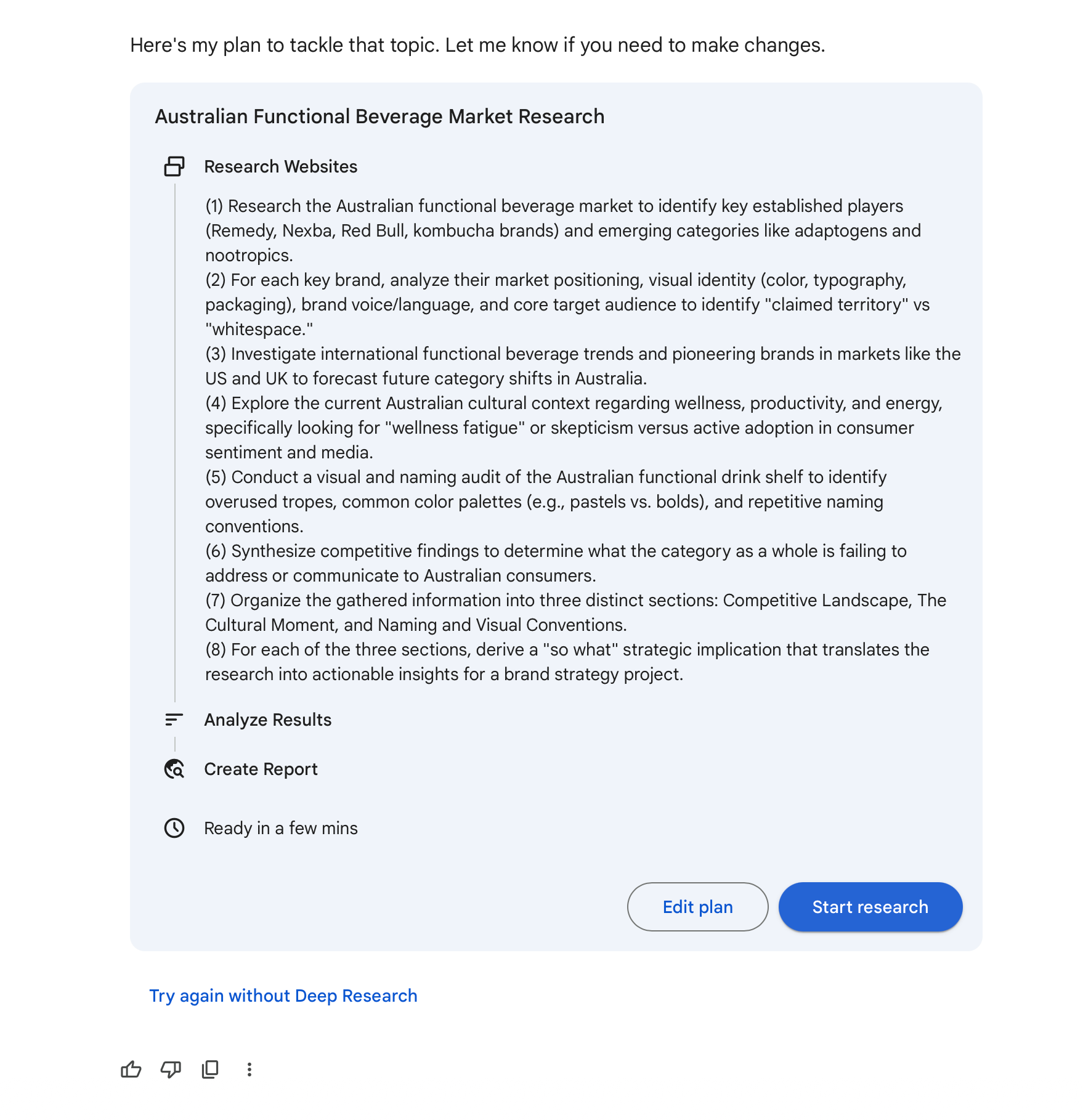
Open Gemini Deep Research and brief it to investigate your category — competitive landscape, white space, audience mindsets, cultural tensions, and what existing brands are getting wrong.
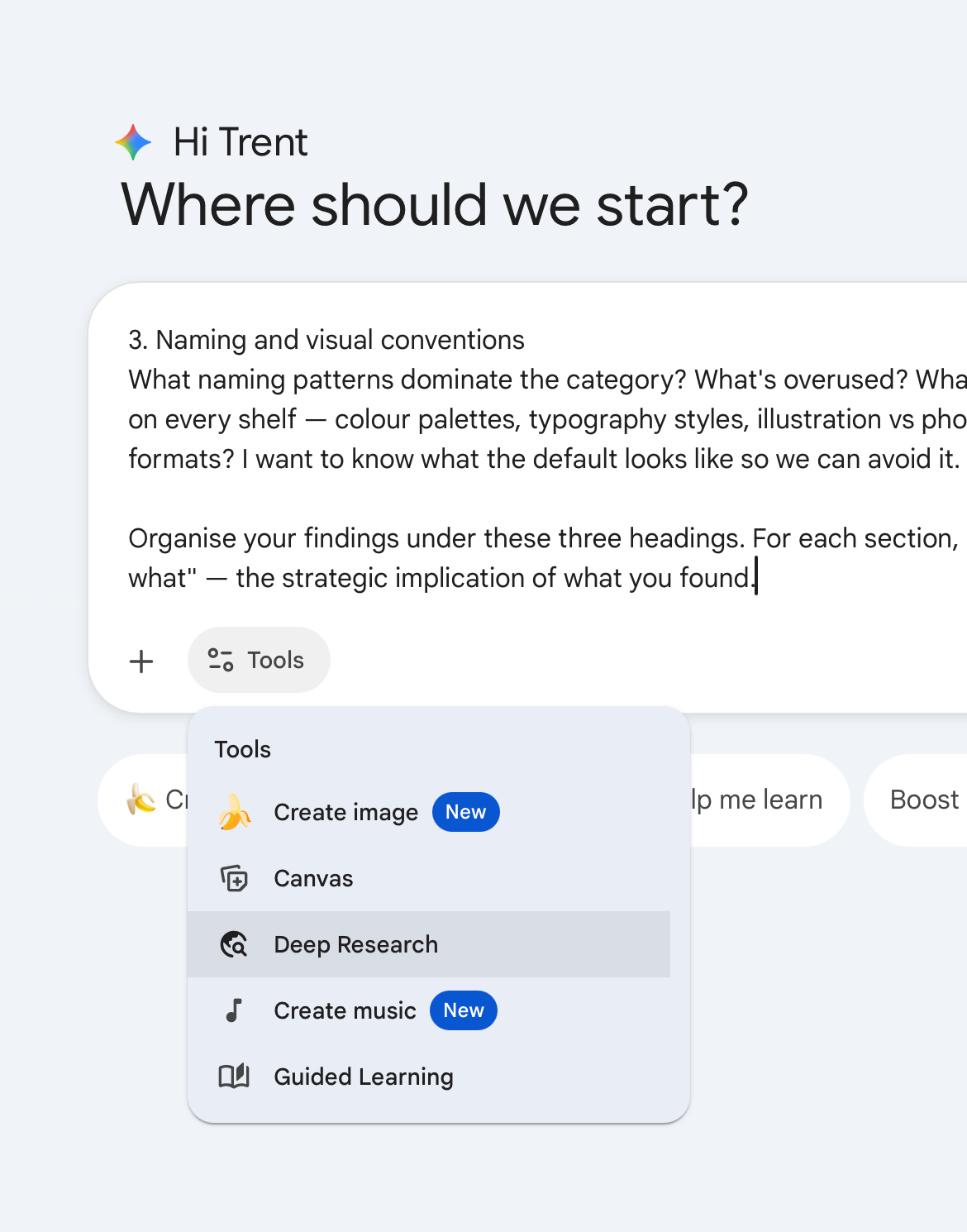
Hit go. This runs during dinner.
This is prompt chaining — using the output of one tool as the input for the next. What Gemini finds becomes the raw material Claude works with after the break.
Extract what mattersPrompt chaining
Your research is back. Paste the full output into your Google Doc, then into Claude and ask it to extract the most interesting audience mindsets, the strongest brand enemies, the cultural tension in the category, and any white space that feels unclaimed.
Ask for options, not conclusions. You're not asking Claude to make your strategy — you're asking it to surface possibilities. The decisions are yours.
Paste Claude's extraction into your Google Doc.
Make four decisionsRole prompting
Work through these in order. For each one, assign Claude a role before you ask — this is role prompting. Same question, different expertise, different answer.
1 Pick your audience
Ask a cultural strategist for three distinct audience options. Review them, pick one. Claude will push back and ask you to justify it. Sit with it before you confirm.
2 Pick your enemy
Ask a brand strategist for three things this brand could position itself against. Not a competitor — an attitude, a behaviour, or a category cliche. Pick one.
3 Pick your tone
Three options only: irreverent, understated, or earnest. Ask Claude to make the case for each given your audience and enemy. Pick one.
Irreverent
Confident, slightly cheeky, willing to poke fun at the category. Doesn't take itself too seriously.
Understated
Quiet confidence. Says less, means more. Premium without performing it.
Earnest
Genuine, warm, direct. Believes in what it's doing without being preachy about it.
4 Pick your word
If this brand could own one word in the mind of the consumer, what would it be? Ask for three options with the logic behind each. Pick one.
These four decisions are where sixty people in the room become sixty different brands. Same brief, same tools — the decisions compound.
Before next Thursday
- Your Google Doc is your record — make sure everything is in there
- Set up your brand project folder in OpenWebUI
- Full documentation is on its way — if you didn't finish something tonight, complete it before Session 2
Next week: naming, visual identity, and building an AI assistant that knows your brand inside out.
Techniques you used tonight
| Technique | What it is |
|---|---|
| Prompt chaining | Using the output of one tool as the input for the next |
| Role prompting | Assigning Claude a role before asking — changes the angle of the answer |
Didn't finish everything? No worries. Full documentation is provided so you can complete anything before next Thursday. The next session doesn't require tonight to be 100% complete — but your deliverables will make it much smoother.